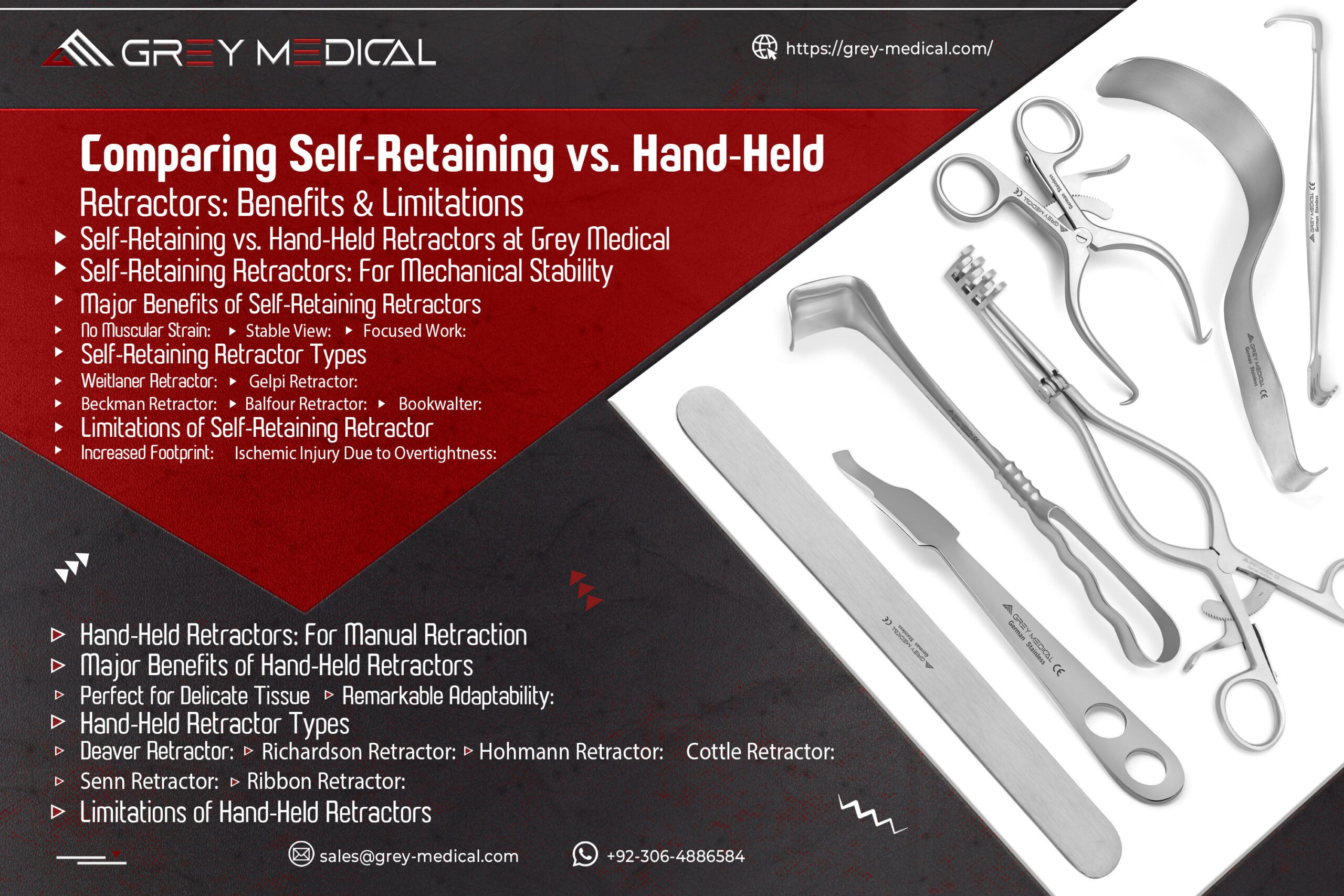
Comparing Self-Retaining vs. Hand-Held Retractors: Benefits & Limitations
Self-retaining vs. hand-held retractors is an interesting debate. In the complex surgical world of today, visualisation means a lot for patient safety. Therefore, for a clearer view, surgeons use retractors. These tools help push away the organs or any anatomical structure that obstructs the view. However, not every retractor has the same quality. Choosing between self-retaining and hand-held retractors determines all the factors, from team involvement to exhaustion.
This Grey Medical guide will walk you through the comparison between self-retaining and hand-held retractors, along with their benefits and limitations. Read to get to know better!
Self-Retaining vs. Hand-Held Retractors at Grey Medical
It is important to keep the surgical site stretched open at all times. A retracted surgical field allows the surgeon to manipulate and navigate the site with ease. Therefore, to facilitate this function, surgical units have come up with self-retaining and hand-held retractors.
The former helps surgeons during long surgery hours by holding the surgical wound open. The hand-held retractors require active pressure on the handle to keep the instrument open.
Choosing the right retractor determines the overall performance of the surgery. Therefore, it is important to look into their major benefits, limitations and types.
Self-Retaining Retractors: For Mechanical Stability
Some retractors use mechanical mechanisms such as spring-loaded frames, ratchets, and screws to keep the tool open. These retractors are known as self-retaining retractors.
Usually, in complex surgical fields and long surgical duration, practitioners prefer retractors which can hold themselves open. Therefore, self-retaining retractors help them in achieving the desired outcome.
Major Benefits of Self-Retaining Retractors
Given are the major benefits of self-retaining retractors, such as:
- No Muscular Strain: Firstly, what makes self-retaining retractors the perfect choice is that they help surgeons keep their hands free. Once their hands are free, they can pay more attention to other processes like suturing or suction.
- Stable View: Additionally, a self-retaining retractor provides a stable view. The hands can shake, but once a self-retaining retractor has been fastened in place, no one can move it. Therefore, in today’s time, when microsurgeries benefit the surgeon with their precision, it is important that surgeons have self-retaining retractors.
- Focused Work: Furthermore, complex operations can go on for a long time. During such a time, it can be difficult to maintain one’s attention. Therefore, surgeons take help from self-retaining retractors. In this way, surgeons can keep all their attention on the major work.
Self-Retaining Retractor Types
The common types of self-retaining retractors are given below, precisely:
Weitlaner Retractor: Typically, the Weitlaner retractor uses a ratchet lock mechanism to keep the prongs retracted. Usually, it is used for superficial procedures. Surgeons also use this for plastic surgery when needed.
Gelpi Retractor: Mostly, during spine surgeries, surgeons need to navigate narrow spaces. The Gelpi retractor is used. It has angled tips, which once locked, keep the surgical site retracted.
Beckman Retractor: This curved jaw retractor is mostly used for spinal and hip procedures.
Balfour Retractor: The abdominal walls must remain retracted for easy access to the surgical site. Therefore, the Balfour retractor is used with its side arms.
Bookwalter: This retractor in particular uses the modular ring system. It has interchangeable blades for wide exposure in the pelvis.
Similarly, the practitioners can use the Thompson retractor, Adson retractor, and Finochietto retractor, among others.
Limitations of Self-Retaining Retractors
The self-retaining retractors also have some limitations which must be kept in mind during operation. Consider these below:
- Increased Footprint: Overall, the self-retaining retractor has a bulky presence. Due to their structure, they sometimes get in the way of the surgeon’s view.
- Ischemic Injury Due to Overtightness: Sometimes, the practitioners might overtighten the self-retaining retractor. This can lead to tissue ischemia. Ischemia is restricted blood flow, which can lead to complications. Furthermore, the nerve may also get compressed if not handled accurately.
Hand-Held Retractors: For Manual Retraction
Surgical practitioners prefer controlling the surgical field. Sometimes, the self-retaining retractors act too mechanically for the job. Therefore, surgeons use hand-held retractors. These retractors must be handled manually. Mostly, a practitioner or someone from the surgical team keeps holding the instrument in place. This allows them to practice control over the organ.
Major Benefits of Hand-Held Retractors
The hand-held retractors hold a bunch of advantages over self-retaining retractors. Let’s study them in detail:
- Perfect for Delicate Tissue: Firstly, as a human holds the retractor in place, they can feel the amount of pressure applied. This gives them a signal for further adjustment. Ideally, they work well for major blood vessels, which must be retracted carefully.
- Remarkable Adaptability: Furthermore, these tools leave margin for adjustments. There may be times when surgeons require a different angle. At that moment, the team can make adjustments in seconds.
Hand-Held Retractor Types
Knowing the examples of hand-held retractors helps surgeons choose the right instrument for the job. Below is a quick overview for your understanding, precisely:
Deaver Retractor: For abdominal and thoracic surgery, the surgeons use the Deaver retractor. These have curved jaws for deep retraction.
Richardson Retractor: Typically, this retractor holds similarities with the Deaver, but it has a handle at the end. Usually, surgeons use this to expose the abdomen.
Hohmann Retractor: These retractors work well on bones and joints. Therefore, surgeons use these for orthopaedic surgeries.
Cottle Retractor: During nasal or plastic surgery, light pronged retractors must be used. The Cottle retractor ticks all the boxes.
Senn Retractor: The Senn retractors have blunt and small prongs. They work on superficial tissues.
Ribbon Retractor: This retractor has a flexible metal band. Mostly, surgeons use this to expose broad surgical sites.
Among the different hand-held retractor types, we also have the Army-Navy retractor, the Volkmann retractor, and the Rake retractor, among others.
Limitations of Hand-Held Retractors
Given limitations must be considered while choosing any type of hand-held retractor. Knowing the limitations helps you decide the right tool for the job:
- The Fatigue Factor: Firstly, it should be noted that the hand-held retractors must be held at all times. During such an affair, the fatigue factor is real.
- Staffing Requirements: Hand-held retractors require a dedicated staff member. Sometimes, in understaffed surgical settings, this can be a major problem.
Comparison between Self-Retaining Vs. Hand-Held Retractors
| Feature | Hand-Held Retractors | Self-Retaining Retractors |
| Operational Control | Manual dynamic | Mechanical dynamic |
| Tactile Feedback | User feels tension | Low mechanical tension |
| Operating Room Efficiency | Requires more staff members | No staff member required |
| Risk Profile | Minor visibility shifts | Can take Pressure-based trauma |
| Best Use Case | Delicate Tasks | Complex Procedures |
FAQs
Q1: What is the difference between handheld and self-retaining retractors?
Firstly, the handheld retractors require a staff member for constant support, while the self-retaining retractor can hold itself. Secondly, handheld retractors allow the surgeons to adjust the angle of retraction, while the self-retaining retractor, once in its place, can’t change angles.
Q2: What are the major examples of handheld retractors?
The major examples of handheld retractors arfore Deaver, Richardson, and Hohmann.
Perfect the Art of Retraction with Grey Medical’s Premium Collection of Handheld and Self-Retaining Retractors
The process of retraction allows the surgeon to keep the view unobstructed. This function requires top-grade surgical retractors. Grey Medical manufactures different hand-held retractors and self-retaining retractor types with high-grade surgical-grade German stainless steel. Comparing Self-Retaining vs. Hand-Held Retractors helps us get an idea about choosing the right tool. Furthermore, all our surgical retractors are CE and FDA-approved. If you are looking for high-grade retractors, contact us for the best deals right now!