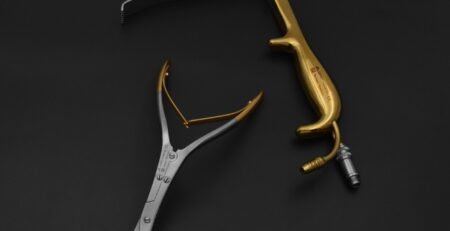
Top 5 Uses and Benefits of Hand-Held Retractors in General Surgery
Hand-held retractors assist the general surgical practitioners and other surgical teams with unparalleled dexterity. They help hold and pull back the hindering organs, tissues, and muscles that come in the way of surgical manipulation. Resultantly, this helps keep a clear surgical site, granting a better view for smooth functioning. Grey Medical houses a range of different hand-held surgical retractors with different configurations, styles, and sizes.
This guide will walk you through the top 5 uses and benefits of hand-held retractors in general surgery. Therefore, brace up and continue reading to explore more in this field!
A Grey Medical Guide to Uses and Benefits of Hand-Held Retractors
What are Hand-Held Retractors?
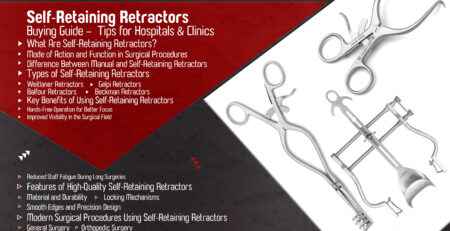
Hand-held surgical retractors belong to a class of manual medical tools which help keep the organs, tissues, nerves, and muscles retracted. Unlike self-retaining retractors, which require active handling for purposeful manipulation, hand-held retractors should be held at all times.
Typically, due to their functioning, they are made lightweight with better gripping handles to avoid surgical strain during surgical hours. However, it should be noted that hand-held retractors are not to be used on long surgeries. They facilitate shorter general surgeries and other surgical procedures, wherever needed.
Examples of Hand-Held Retractors
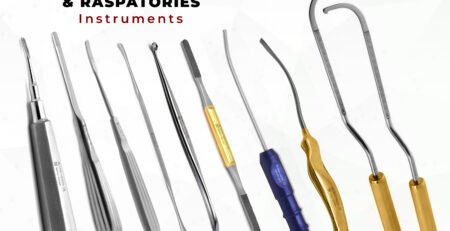
Generally speaking, the surgical field has a vast variety and range of hand-held retractors with dedicated functions. A few major examples are mentioned below:
- Army-Navy retractor: Facilitates the retraction of superficial wounds, usually in general surgical procedures.
- Richardson retractor: Helps stretch and pull back deep tissues in abdominal surgical procedures.
- Farabeuf retractor: A favourite of many for its versatility. It covers the functions of retraction during dentistry and hernia repair.
- Hohmann retractor: Keeps the orthopaedic surgical field exposed.
- Ribbon retractor: Can bend in various shapes for exposing deep wounds.
- Senn retractor: Double-ended retractor for keeping the surgical field retracted during small bone procedures.
- Deaver retractor: Facilitates chest and deep abdominal surgeries to hold organs like the liver.
- Meyerding retractor: Unsung warriors of spinal and neurosurgery, helping retract bones and muscles.
Uses of Hand-Held Retractors
Given is a quick overview of some of the major uses of hand-held retractors. Get acquainted with these for a better understanding of general surgical fields:
Helps retract the Skin
Usually, surgeons employ surgical hooks as hand-held retractors to pull back the layers of the skin. Once in action, they keep the many layers of the skin held back for a better view of the surgical field. Surgeons mostly require hand-held surgical retractors during the closing of the wound and suturing. Grey Medica manufactures a variety of different configurations and sizes of skin hooks.
However, mostly, skin hooks of size 11-15 cm are preferred. Typically, skin hooks use the method of “puncturing” for retracting the skin. Conversely speaking, this method of retraction serves better than grasping, as the skin is more tolerant of this procedure. Senn retractors with an L-shaped double end are seen as the prime example of this category.
Helps retract the muscles
Usually, for retracting the muscles, surgeons prefer using curved blades with a moon-like formation. These help adjust to the anatomic curves of the muscles. Typically, Langenbeck, Richardson, Army-Navy, and Farabeuf retractors provide atraumatic retraction of the surgical wound.
Interestingly, these hand-held surgical retractors now come with a built-in LED surgical light and fibre optic set-ups to help keep the surgical wound lit up. This helps illuminate the often dark surgical sites for better visibility. Usually, surgeons prefer the Meyerding surgical retractor to keep the muscular surgical site wide open.
Facilitates the Retraction of organs
Organs can hinder the surgical view, considering that most of the anatomical structures overlap. However, organs too can not be handled with any invasive surgical tool. For this purpose, general surgeons require atraumatic hand-held retractors with blunt ends and curved structures to mould as per the anatomical curves of the body.
Majorly, the Deaver retractor is used for this purpose. It is used during cholecystectomies, thoracic surgeries, and abdominal surgeries to pull back organs like the liver, lungs, and gallbladders. Furthermore, the Ribbon retractor can also be used to retract the organs. Typically, they are curved and flat for carefully holding the surgical organs.
Assists in pushing aside the blood vessels
Vascular surgeries feature a complex network of blood vessels, such as the carotid, the abdominal aorta, the axillary, and the lower extremity arteries. Therefore, a very carefully designed blood vessel retraction comes to the rescue. Usually, the Wylie renal vein retractor comes in handy. This helps retract without occlusion.
Once used, these hand-held retractors help reduce the chances of thrombosis, which is a halt in blood flow leading to clotting. Moreover, surgeons also use the Cushing vein retractor for this purpose. It is usually preferred for its terminally curved blade.
Aids in retracting nerves
In spinal procedures and surgeries like laminectomies and discectomies, nerves must be held back and atraumatically pushed for better visibility. Usually, there are many nerve retractors like Love, Smithwich, Horn, and Dandy, among others. They work to retract nerve roots and spinal nerves during long surgical hours for better visibility. Furthermore, general surgeries may involve the use of sharp cutting instruments. These retractors help the nerves stay out of active manipulation.
Additional Use: Aids in Veterinary surgeries
There is a separate category of hand-held retractors in smaller and compact form for use in veterinary surgeries. Usually, a smaller Hohmann retractor assists veterinary surgeons in handling and retracting the different organs and layers of skin during surgeries. When needed, surgeons usually take the smaller versions of human retractors for the same manipulation.
Perfect the Art of General Surgery with Grey Medical’s Hand-Held Retractors
Whatever the need, hand-held retractors come in handy during quick general surgical procedures. They allow the surgeons to have a better view of the surgical site, thereby increasing the chances of successful surgical manipulation. Grey Medical houses a range of different types of hand-held retractors. If you are looking for safe and compact hand-held surgical retractors, contact us now!