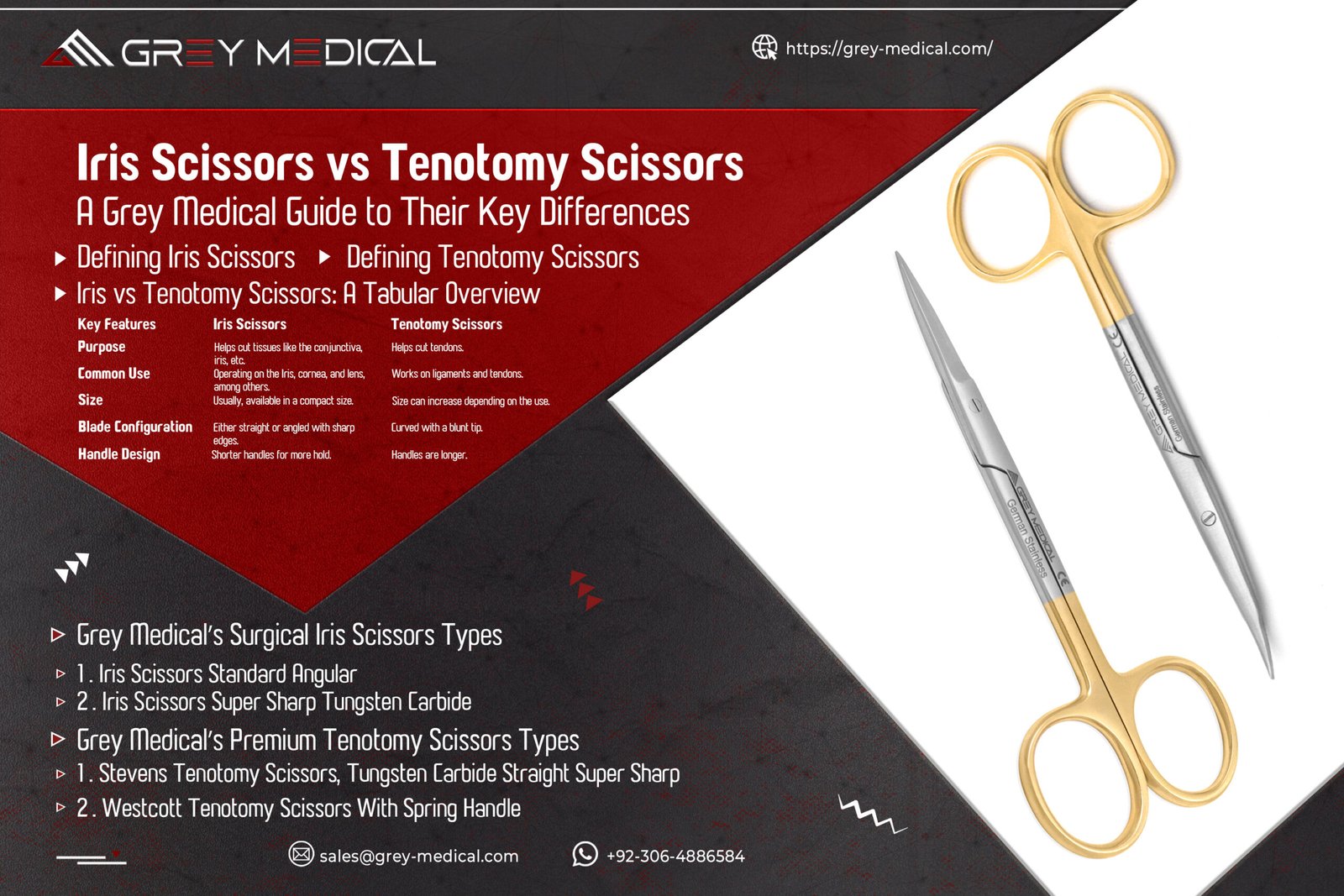
Iris Scissors vs Tenotomy Scissors: A Grey Medical Guide to Their Key Differences
Iris vs. Tenotomy scissors can be a little difficult to tell apart. It is important to know the differences between surgical scissors for accurate application. Knowing the uses and particular features of every surgical scissor is important for an efficient surgical field. Grey Medical promises a surgical world of patient comfort and best results with their top-grade surgical instruments. We have a range of surgical scissors, each serving a specific surgical site.
This Grey Medical guide will help you grasp the key differences between Iris and Tenotomy scissors, with their features and uses. Continue reading to explore!
Defining Iris Scissors
Ophthalmologists use Iris scissors to operate on the Iris. These scissors are specialised for ophthalmic uses, crafted to address the issues of vision. Most typically, technicians use German stainless steel to manufacture these scissors. The instrument serves the following purposes, precisely:
- Usually, it helps operate on the Cataract to remove the diseased lens.
- Furthermore, it finds usage during a corneal transplant.
- During conjunctival surgery, it helps suture the conjunctiva.
- During Iris Goniotomy procedures, Iris scissors work to create new openings.
Mostly, the manufacturers craft them in palm-held and finger-ring configurations. Typically, they stand out due to their sharp tips.
Defining Tenotomy Scissors
Unlike Iris scissors, this pair of scissors is designed to facilitate the cutting of the extraocular muscles of the eyes. These muscles control the movements of the eyes. The tenotomy scissors facilitate the functioning of the following procedures, such as:
- Typically, during trabeculectomy, ophthalmic surgeons need to drain the aqueous humour. Therefore, they use tenotomy scissors to notch a cut.
- After cataract surgery, surgeons may need to notch a precise cut in the posterior capsule. Usually, they use the tenotomy scissors.
- Furthermore, muscles can be operated on for tightening with the help of tenotomy scissors.
Additionally, the tenotomy scissors have precise tips and sharp edges to allow the surgeons to make on-point cuts.
Iris vs Tenotomy Scissors: A Tabular Overview
For your convenience, we have formulated a tabular construction to state the difference between the Iris and Tenotomy scissors. Note:
| Key Features | Iris Scissors | Tenotomy Scissors |
| Purpose | Helps cut tissues like the conjunctiva, iris, etc. | Helps cut tendons. |
| Common Use | Operating on the Iris, cornea, and lens, among others. | Works on ligaments and tendons. |
| Size | Usually, available in a compact size. | Size can increase depending on the use. |
| Blade Configuration | Either straight or angled with sharp edges. | Curved with a blunt tip. |
| Handle Design | Shorter handles for more hold. | Handles are longer. |
Exploring Grey Medical’s Product Catalogue
Below is a quick overview of Grey Medical’s major types of Iris and Tenotomy scissors. For your information and guidance, we have enlisted the different types and uses.
Grey Medical’s Surgical Iris Scissors Types
1. Iris Scissors Standard Angular
Typically, Iris scissors are available in standard and angular forms. They work on the Iris and conjunctiva in procedures like lens extraction, corneal transplant, and iris iridectomy, among others. Usually, they feature a special kind of probing tip which is slightly curved to fit the anatomy of the eye. Overall, we make sure all our surgical scissors feature a blunt side to protect the normal tissues of the eye.
2. Iris Scissors Super Sharp Tungsten Carbide
These scissors find usage during ophthalmic procedures like vitreoretinal surgery and lens capsulectomy. Here, they help manipulate the conjunctiva and the lens. Usually, they feature a super-cut and sharpened cutting tip for precise cuts. Moreover, they have a TC inserted jaw. With their tungsten carbide construction, the surgeons can go carefree without worrying about corrosion. All in all, it serves the purpose with efficiency.
Grey Medical’s Premium Tenotomy Scissors Types
1. Stevens Tenotomy Scissors, Tungsten Carbide Straight Super Sharp
The tough connective tissues are handled by Stevens tenotomy scissors as they feature a super-cut edge. Typically, they work wonders while assisting in muscle surgery for strabismus and YAG laser capsulotomy. Cherry on top, these surgical scissors feature a ring handle for added comfort. On the whole, it is perfect for long surgical hours.
2. Westcott Tenotomy Scissors With Spring Handle
Surgical procedures like Trabeculectomy and limbal relaxing incisions make use of Westcott tenotomy scissors with a spring handle. They feature a palm handle. This helps surgeons who find it difficult to use finger ring handles. Moreover, the instrument features a knob for locking the scissor in place. Once the instrument is locked, ophthalmologists can manipulate the tissues with ease.
FAQs
Q1: Are Tenotomy Scissors costly?
Usually, the tenotomy scissors cost somewhere between $15 and $150. Once you get your hands on a durable pair of scissors, it can go a long way. Therefore, considering the many benefits, it is not costly at all.
Q2: How can I remain on a budget while buying surgical scissors?
Mostly, it is recommended to check on different surgical supply stores before placing an order. Grey Medical has an entire range catalogued at an affordable price. Go check on the website and order your budget-friendly surgical scissors now!
Q3: Can Iris and Tenotomy Scissors be used Interchangeably?
No. It is not recommended to use these two scissors interchangeably, as this can damage the delicate structures of the eyes. Each ophthalmological scissor is crafted to serve a particular function. Therefore, using interchangeably is never encouraged.
Elevate Your Surgical Game with Grey Medical’s Iris and Tenotomy Scissors
Grey Medical believes in elevating your surgical game to the next level with its unmatched quality and dexterity. All our surgical scissors are made with surgical-grade stainless steel, supplemented with tungsten carbide in places. We have gotten our tools approved by CE and FDA. If you are looking for a revamp or want to modify your surgical kit, contact us now!