
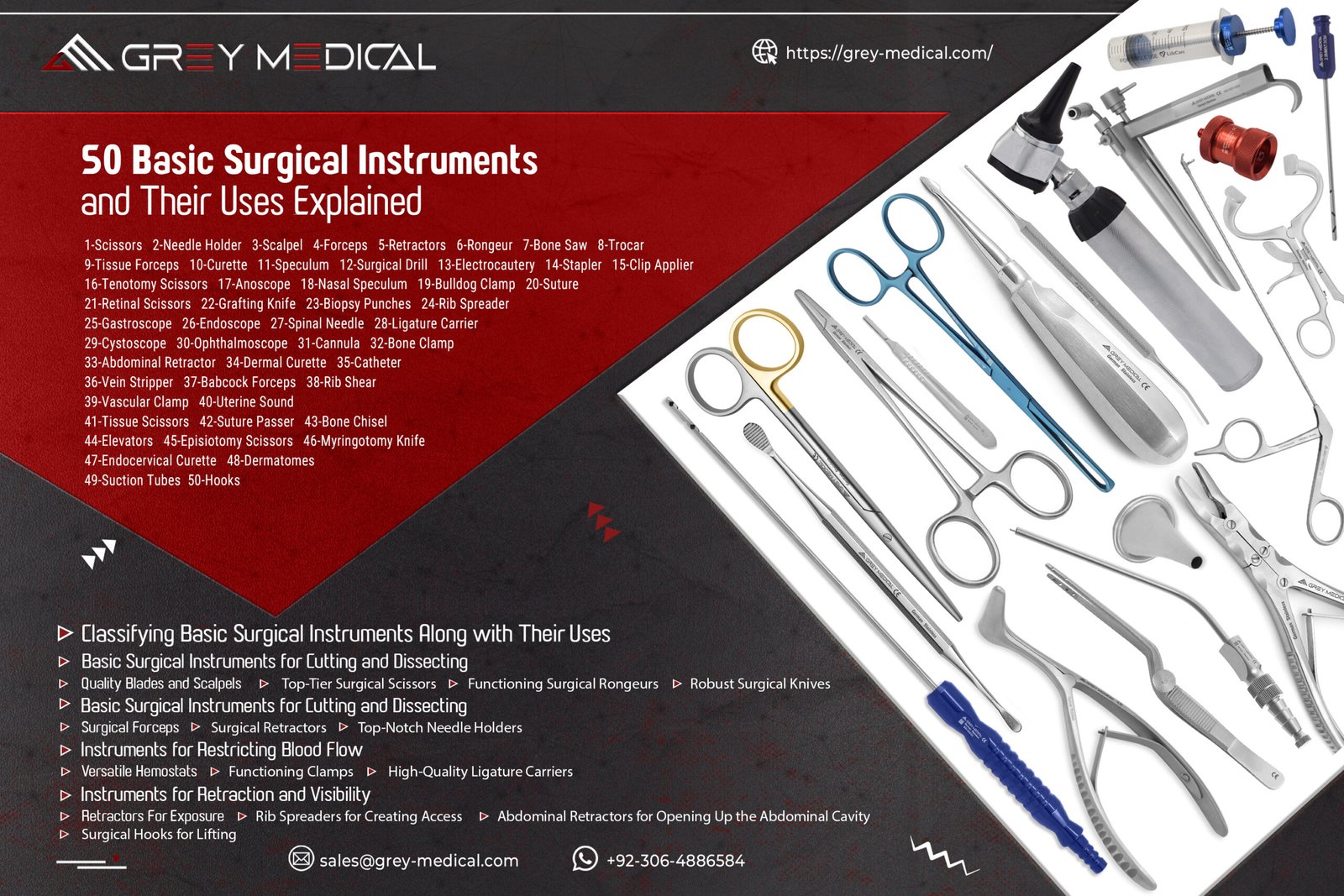
50 Basic Surgical Instruments and Their Uses Explained
Basic surgical instruments are the lifeblood of every surgical procedure. They are crafted to assist every domain of surgical speciality where they streamline the procedures. Whether there is a need to cut a tissue or perform a detailed dissection, their role is indispensable. Grey Medical is a licensed medical supply store serving the field of surgery for well over 20 years with remarkable dexterity and commitment.
In this guide, we will walk you through the specifications of 50 basic surgical instruments at Grey Medical, along with their uses. Continue reading to explore!
Table of 50 Basic Surgical Instruments with Their Respective Uses
| Sr. No. | Names of Basic Surgical Instruments | Uses and Applications in Surgery |
| 1 | Scissors | Cutting an incising bodily structures, tissues, and other surgical material |
| 2 | Needle Holder | To control and drive the needle during suturing |
| 3 | Scalpel | To precisely cut and incise |
| 4 | Forceps | To grasp and hold the tissues |
| 5 | Retractors | Keeping the surgical field wide open for maximum visibility |
| 6 | Rongeur | To excavate fragments of the bone |
| 7 | Bone Saw | For cutting hard and bony structures |
| 8 | Trocar | To make access points for minimally invasive surgeries |
| 9 | Tissue Forceps | To hold and operate on tissues |
| 10 | Curette | To scrape down the tissues |
| 11 | Speculum | Keeping the body cavities open |
| 12 | Surgical Drill | Making holes in the bony structures |
| 13 | Electrocautery | To coagulate the blood vessels |
| 14 | Stapler | Closing the operated wounds |
| 15 | Clip Applier | To clip the vessels close |
| 16 | Tenotomy Scissors | For incising tendons |
| 17 | Anoscope | Examining tool designed for anus and rectum |
| 18 | Nasal Speculum | To analyse the nasal passages |
| 19 | Bulldog Clamp | To occlude the blood vessels |
| 20 | Suture | To stitch the wounds |
| 21 | Retinal Scissors | For precise cutting of eye tissues |
| 22 | Grafting Knife | Used in implant procedures to prepare for the grafts |
| 23 | Biopsy Punches | To obtain samples of bodily structures such as tissues |
| 24 | Rib Spreader | For thoracic procedures, to keep the ribcage open |
| 25 | Gastroscope | To examine the gastrointestinal tract |
| 26 | Endoscope | For detailed screening of internal structures |
| 27 | Spinal Needle | Withdrawing bodily fluids and injecting anaesthesia |
| 28 | Ligature Carrier | To tie the ligatures |
| 29 | Cystoscope | For an in-depth analysis of the urinary bladder |
| 30 | Ophthalmoscope | To picture the interior of the eye |
| 31 | Cannula | To drain the fluids |
| 32 | Bone Clamp | To keep the bone fragments in place |
| 33 | Abdominal Retractor | Keeping the abdominal cavity wide open |
| 34 | Dermal Curette | To manipulate the skin lesions |
| 35 | Catheter | To draw out fluids |
| 36 | Vein Stripper | Taking the varicose veins out |
| 37 | Babcock Forceps | To hold and work on the delicate tissues |
| 38 | Rib Shear | Cutting the ribs and the rib cage |
| 39 | Vascular Clamp | To occlude the blood vessels |
| 40 | Uterine Sound | Used to measure the uterus and its depth |
| 41 | Tissue Scissors | To incise tissues |
| 42 | Suture Passer | To pass sutures through tissues |
| 43 | Bone Chisel | Shaping bones |
| 44 | Elevators | To elevate and retract tissues |
| 45 | Episiotomy Scissors | To make cuts during childbirth |
| 46 | Myringotomy Knife | To incise the eardrum |
| 47 | Endocervical Curette | Assessing the endocervical canal |
| 48 | Dermatomes | To cut skinny slices of the skin |
| 49 | Suction Tubes | To remove secretions and other bodily fluids |
| 50 | Hooks | For retraction and stabilization of the tissues |
Classifying Basic Surgical Instruments Along with Their Uses
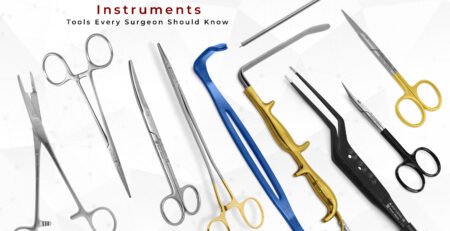
Surgical equipment is classified into four basic types. Broadly, the category includes common operating room surgical tools, general surgery instruments, basic surgery equipment, and specialised operating tools.
Practically, the classification follows the usage, taking into consideration all 50 basic surgical instruments.
Let’s dig into the indispensable basic surgical instruments and their usage!
Basic Surgical Instruments for Cutting and Dissecting
Instruments for cutting and dissecting, as the name suggests, are basic surgical instruments for making an incision and cutting the undesired part during a surgery.
Some of the major instruments for cutting and dissecting are discussed below:
Quality Blades and Scalpels
Mostly, surgeons use scalpels and blades to practice precise cutting. These are basic surgical instruments consisting of a sharp blade fixed to an ergonomic handle. At Grey Medical, blades and scalpels are available in different configurations and sizes to suit the needs of all. Majorly, they are used to create access points and keep the incision precise during dissection.

Top-Tier Surgical Scissors
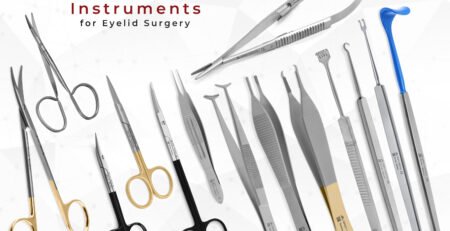
Surgical scissors are vital cutting surgical tools. They are used in nearly every surgical procedure. Broadly speaking, they are either curved or straight. The former helps in reaching inaccessible places while the latter is ideal for superficial cutting and dissecting. Usually, blade size is selected according to the task at hand. Finer blade enhances precision, while broad-blade scissors help cut sutures and other sturdy structures.

Functioning Surgical Rongeurs
Commonly, functional surgical rongeurs are specialised surgical tools used to cut and pick up bones and bone fragments during surgery. They are mostly used in orthopaedics, neurosurgery, and facial surgeries.

Robust Surgical Knives
Surgical knives are sharp, cutting surgery tools designed to make incisions. They allow deep tissue access and are minimally invasive due to their structure. Typically, they come with varying blade sizes and configurations to provide customized application to the surgeons.
Instruments for Holding
Among the basic surgical instruments, surgical tools for holding are the most crucial. They are used to hold different structures, organs, materials, and even equipment during a surgical procedure to keep a controlled environment.
Some of the major instruments for holding are discussed below:
Surgical Forceps
Surgical forceps are constructed with two arms joined at a hinge with a handle to hold the instrument. Medical professionals pick the type of forcep according to the task at hand. Serrated forceps are used to practice maximum control, while dressing forceps are used to place dressings and bandages, etc.
Surgical Retractors
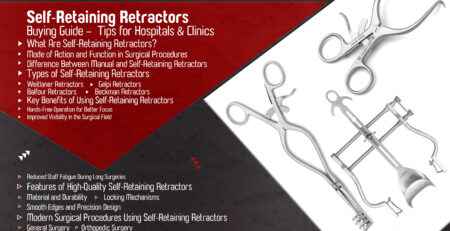
Surgical retractors allow the surgeons to maximise the field of vision by exposing the surgical field. They are used to push aside the tissues for better visibility. Depending upon the level of control required, retractors can be acquired in different configurations. Hand-held retractors are used during general surgeries, while self-retaining retractors are used during complex procedures.
Top-Notch Needle Holders
Needle holders are used during surgical procedures to drive and control the needles. Surgeons employ them to implant sutures. With needle holders, surgeons can avoid needle slippage, which can harm the nearby tissues.
Instruments for Restricting Blood Flow
Hemostatic instruments are one of the basic surgical tools used to constrict blood flow. Typically, hemostats are used to keep the surgical field clear of any fluids, especially blood. It also prevents blood loss, which can put a patient in danger.
Some of the instruments of this category are briefly explained below:
Versatile Hemostats
Also known as artery forceps, hemostats are standardised clamping surgical tools. They are made with serrated jaws and a smooth handle. The jaws clamp down on the tissues and arteries to stop the bleeding. While the handles provide maximum control. Major hemostats include Kelly forceps, Rochester-Carmalt forceps, and Mosquito forceps.

Functioning Clamps
Clamps are used to obstruct the blood flow. They are profusely used during surgeries, obstetrics, vascular, and gastrointestinal surgeries to control the loss of blood. Majorly, this category holds Kocher clamps, Satinsky clamps, and bulldog clamps as its chief contributors.

High-Quality Ligature Carriers
Mostly, ligature carriers are used to control the blood flow in smaller vessels. They work best on delicate blood vessels. They are made with extremely delicate and lean shafts to exercise maximum control over the arteries. Fergusson ligature carriers and Schaedel ligature carriers are some of its major types.

Instruments for Retraction and Visibility
Instruments for retraction are basic surgical instruments used for holding and separating the tissues and organ structures. This allows the surgeons and practitioners to navigate the complex anatomical structures with ease and comfort.
Below is a quick round-up of some of its chief types:
Retractors For Exposure
Retractors are one of the major basic surgical tools. They enable practitioners to increase visibility by exposing the surgical field. Available in different sizes, retractors can be put to use in nearly every domain of surgery. Depending upon the mechanism, they are available as hand-held, self-retaining, and army-navy retractors.

Rib Spreaders for Creating Access
The thoracic cavity needs to be kept open during surgeries. Rib spreaders are used for this purpose. They help the practitioner spread the ribs open for better visibility and access. Once the rib cage is spread out, surgeons can easily manipulate the organs for procedures like Cardiac surgeries and Lung resections. Cooley and sternal retractors are some of its chief types.
Abdominal Retractors for Opening Up the Abdominal Cavity
Abdominal muscles should be retracted to gain access to the internal bodily structures. For this purpose, abdominal retractors are used. Usually, surgeons use these for surgeries like Organ resections and hernia repairs.
Surgical Hooks for Lifting
Surgical hooks are curved, basic surgical tools for lifting the muscles and tissues during the surgical procedure. They find immense usage in brain surgery, ophthalmology, and plastic surgery, among others.
FAQs
Q1: What are the top basic surgical instruments for surgeries?
The top basic surgical instruments are found in nearly every surgical field because of their application. Scalpels, surgical scissors, retractors, forceps, and hooks fall under this category.
Q2: How to increase the longevity of basic surgical equipment?
To keep your surgical equipment spick and span, it is important to keep them sterilized and cleaned properly after use. Steam sterilisation works wonders when you want to get rid of harmful microbes while at the same time keeping the equipment fresh as new.
Shop Grey Medical’s 50 Basic Surgical Instruments for Surgical Excellency
Keeping your surgical kit updated with quality instruments is crucial for optimum surgical performance. Basic surgical instruments are absolutely necessary in every surgical procedure for navigating the surgical field with utmost skill. We at Grey Medical have been serving the field for well over 20 years, with world-class efficiency and quality. All our surgical instruments can be ordered online by prebooking through contact us. Whether you are a newbie or a seasoned practitioner, our facility holds ready-made solutions for you. Further, at our facility, your orders are in safe hands as we use trusted shipping services like FedEx, DHL, etc.





Comments (2)
This is a very informative overview of basic surgical instruments. Clear classification and explanations make it helpful for medical students and healthcare professionals. Looking forward to more detailed insights on specialized instruments
Alat Operasi manusia dirumah sakit