

Plastic Surgery Instruments – Precision Tools for Cosmetic & Reconstructive Procedures
Plastic surgery instruments, as the name suggests, are a dedicated collection for reconstruction and cosmetic procedures. From skin grafting to tissue handling, this surgical domain comprises highly specialised tools with different tips and edges.
Grey Medical is a trusted surgical supply store working to deliver the best of the surgical domain to the world. We have a collection of medical instruments well-suited to meet the changing demands of the surgical world.
In this Grey Medical guide, we will walk you through a quick guide on plastic surgery instruments. Moreover, we will discuss the tools included in different reconstructive procedures of this surgical domain. Continue reading to explore!
Introduction to Plastic Surgery Instruments
The world of surgery learns from experimentation to deliver the best to the medical domain. Just like other dedicated fields, plastic surgery instruments perform fine work for different cosmetic procedures. For example, this surgical field includes dermatomes for grafting skin, specialized scissors for fine cutting, microsurgical tools like forceps, and rasps for rhinoplasty, among others.
Buying Guide for Plastic Surgery Instruments
When purchasing plastic surgery tools, it is important to consider the long-term value and safety. It is only a conscious investment in good plastic surgery tools that can bring desirable outcomes. Therefore, we have prepared a buying guide for plastic surgery instruments, which will help you choose the best.
Key Factors to Consider Before Buying
The following key factors should be consciously considered before buying surgical instruments, precisely:
Material Quality and Durability
A good plastic surgery set makes use of 400 high-grade German stainless steel. This helps with ensuring strength and resistance to harm. Furthermore, the recent technicalities have made the use of titanium necessary, as this material is lightweight and works best for microsurgical tools. Moreover, tungsten carbide inserts and tips should be preferred for precise work.
Ergonomic Design and Precision
It should be noted that only those plastic surgery instruments that are well-balanced with non-slipping handles perform well. Therefore, always choose instruments that tick all these boxes. Furthermore, always choose instruments that have a matte finish. This prevents glare and unease during the procedure.
Compatibility With Sterilization Methods
It should be your team’s prime concern to see if the construction materials used are compatible with different sterilisation methods. Additionally, temperatures can fall very low during sterilisation. Always ensure the instruments you are interested in can withstand methods like Ethylene Oxide (EtO).
Types of Plastic Surgery Instruments to Buy
Given is a brief round-up of modern plastic surgery instruments your field can’t do without. Here’s the list:
Cutting and Dissecting Instruments
Some of the major cutting and dissecting instruments used during different procedures of the skin, face, and eyes are:
Scalpels:
- Usually, plastic surgeons require #3 handle with #10, #11, and #15 blades for precise skin incisions.
Scissors:
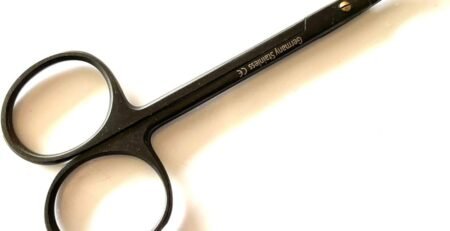
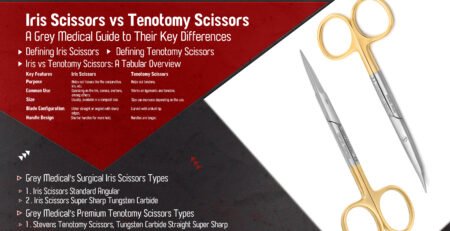
- Iris Scissors: Known for its highly detailed work, Iris scissors are a favorite of plastic surgeons.
- McIndoe Scissors: Fine dissection requires McIndoe scissors.
- Mayo Scissors: Tough tissues require equally tough scissors. For example, surgeons may require Mayo scissors for trimming sutures or fascia.
- Metzenbaum Scissors: Mostly, surgeons use Metzenbaum scissors for deep tissue dissection.
Electrosurgical Devices:
- Monopolar/bipolar Insert: During intricate plastic surgery work, monopolar or bipolar electrosurgical devices work wonders to close vessels.
Instruments for Grasping
Forceps:
- Adson Forceps: Usually, these come as toothed-edge tools. They help surgeons handle the folds of skin during manipulation.
- Russian Forceps: Dense tissue folds can be stabilised with the help of Russian forceps.
- DeBakey Forceps: In case of delicate tissue handling, surgeons prefer DeBakey forceps.
Hemostats:
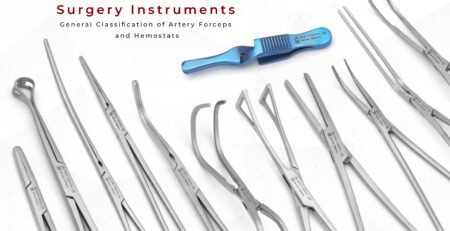
- Crile Hemostat: Typically, surgeons prefer using crile hemostats for closing small vessels. Mostly, straight or curved orientations are found in this field.
- Babcock Clamps: For the major part of the surgery, surgeons rely on Babcock forceps for holding tissues.
Stapling Instruments
Staplers:
Sometimes, plastic surgeons may use surgical staplers to close long incisions.
Needle Holders:
- Mayo-Hegar Needle Holder: This specialised tool helps lessen the chances of surgical fatigue during wound closure. Usually, surgeons use Mayo-Hegar needle holders to drive the needle for this purpose.
Required Retractors for Different Plastic Surgeries
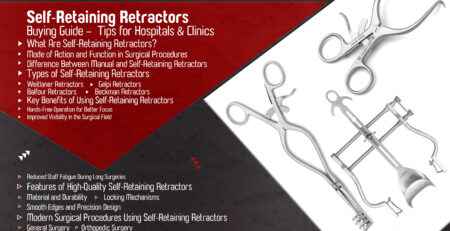
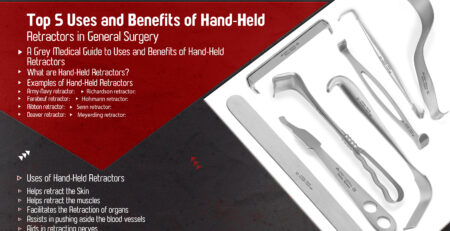
- Senn Retractor: Primarily, the manufacturing unit constructs this retractor with two working ends: a rake and a blade. Mostly, they work wonders to keep superficial incisions open.
- Skin Hooks: Gillies or Kleinert-Kutz hooks help manage and manipulate skin edges. Fortunately, the hook edges are smooth enough to ensure minimal trauma.
- Army-Navy Retractor: Practitioners often use the Army-Navy retractor for medium-depth retraction.
Marking and Measuring Tools
Skin Markers: Mostly, plastic surgeons require skin markers to draw lines and markings for the pre-operative designs. They must be perfect and on point for perfect alignment.
Calipers: Typically, surgical practitioners use calipers to correctly measure the symmetry. Mostly, these are used during breast augmentation and rhinoplasty, among others.
Rulers: Usually, the folds of the skin and skin flaps are measured with the help of rulers.
Best Plastic Surgery Instruments Worth Buying
Out of all the major plastic surgery instruments discussed above, the following must be considered as worth-buying for your surgical practice:
Scalpel & Blades
While purchasing scalpels and blades, make sure you order Swann-Morton Stainless Steel Handle No. 3. Moreover, having a know-how of blade numbers is important. If you are interested in general skin incision, use blade#10. If you are working on stab incisions, prefer using blade#11. Lastly, for curved cutting, blade#15 works wonders.
Adson Forceps
Specifically, Adson tissue forceps with 12cm length and 0.5mm to 0.9mm micro-tips should be preferred. You can also use Adson-Brown Forceps, which come with interlocking teeth for high grip over hard tissues.
Iris Scissors
Fine dissection can be achieved with the help of Iris SuperCut Scissors. They have a microserrated blade for on-point incisions. Furthermore, tissue contours should be tackled with the help of curved Iris scissors. While a straight blade works best for surface-level surgical wounds.
Skin Hooks
Mostly, plastic surgeons prefer using Double-Prong Skin Hooks and Gillies Skin Hooks for flap elevation.
Needle Holders
Needle holders, such as Olsen-Hegar or Mayo-Hegar needles, have been thought of as the best needle drivers for suturing in plastic surgery. If you want to smoothly drive the entire surgery, getting your hands on the recommended items is important.
Why Buying High-Quality Instruments Matters
Here’s why buying high-quality instruments matters for the overall performance of a surgical field:
Surgical Accuracy
A top-grade surgical instrument has perfect formation and accurate contours for the job. Furthermore, every function has a specialised instrument designated for it. Therefore, always consider surgical accuracy over the easy way out.
Patient Safety
Using safe and certified surgical instruments ensures patient safety. It’s because trusted medical supplies seldom corrode or lose their structure. With accurate surgical tools, post-operative complications can be kept at a distance. Hence, using top-notch plastic surgery instruments always keeps patients healthy.
Long-Term Performance
Getting plastic surgery supplies can be costly. Therefore, you should make sure you buy high-grade surgical stainless steel, which can withstand different challenging work environments without getting bad.
Where to Buy Plastic Surgery Instruments
Trusted Online Medical Suppliers
Before purchasing, doing a little homework can save you from a big loss. Always trust a certified surgical supply store online that has its certifications displayed on the website. Usually, the following certifications make the surgical instruments safe to use: CE, FDA, and ISO.
Manufacturer Websites
A well-reputed surgical supply store has every credential and information available online. For instance, Grey Medical has a support page working 24/7 for the guidance of online visitors. From shopping to delivery, every step on our website is well-supported. Even our interface is kept simple for your ease.
FAQs
Q1: Which plastic surgery instruments must be present on the field?
Tools such as rasps, osteotomes, microsurgical instruments, specialised surgical scissors, and elevators must be present on the field. Additionally, it is important to have specula, hooks, and measuring devices ready for use in the plastic surgical field.
Q2: How can you take care of your plastic surgery tools?
The lab practitioners should ensure the plastic surgery tools are properly cleaned after use. Taking care of surgery tools as per the given protocols ensures longevity.
Enhance Surgical Wellness of Cosmetic and Reconstructive Procedures with Grey Medical’s Range of Standard Plastic Surgery Instruments
If you are on the lookout for top-grade tools for reconstructive and cosmetic procedures, you have come to the right place. Whether you are in need of cutting tools or retracting equipment, Grey Medical has opened its store to everyone around the globe. We offer world-class delivery services. Furthermore, our tools are CE and FDA-approved. You can order different plastic surgery kits and instruments by contacting us now!



Leave a Reply