Periosteal Dental Elevator: A Look into the Types, Uses, and Buying Guide
Periosteal dental elevators are every dental surgeon’s cherished handheld surgical tools. Usually, after an incision in implant procedures, oral, and periodontal surgeries, surgeons require elevating tools to retract the mucoperiosteum. These tools are known as a dental periosteal elevator or a periosteal elevator dental instrument. In this way, a full-thickness soft-tissue flap is created, allowing access to the underlying surgical area.
This article addresses the types and features of different periosteal dental elevators. Furthermore, it will discuss the factors one should consider before buying the dental elevators in bulk. Stay tuned!
But What Are Periosteal Dental Elevators?
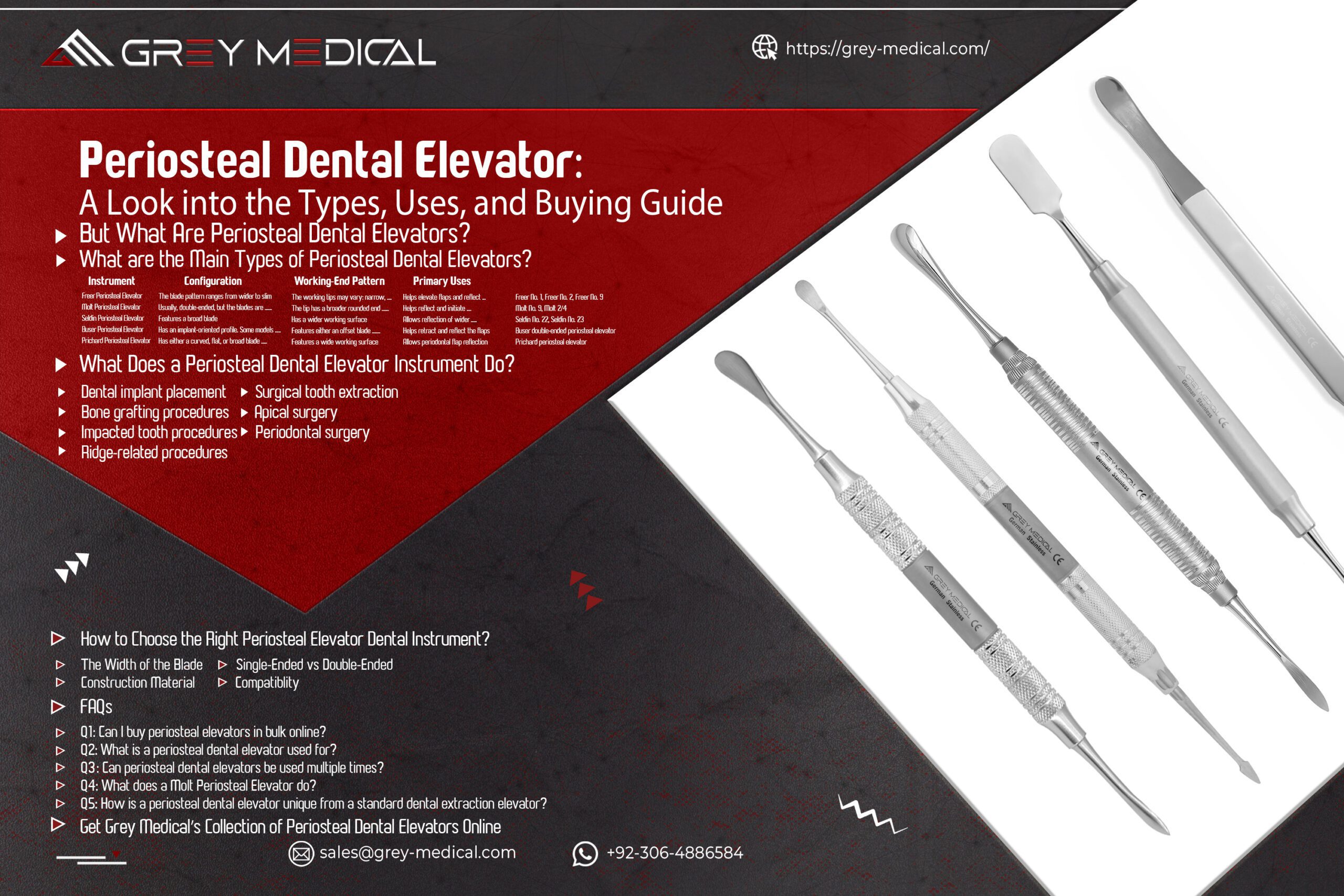
A periosteal dental elevator is a handheld dental surgical instrument constructed to retract the mucoperiosteum after making an incision during different dental procedures. It belongs to the general category of dental elevator instruments. However, a periosteal dental elevator should not be confused with different root elevators. A root elevator helps luxate and remove the root. While a periosteal dental elevator works to reflect the mucoperiosteal flap and elevate soft tissues.
These dental elevators differ in their tip configuration, blade width, and curvature pattern. Every speciality has a particularly designed periosteal dental elevator. An elevator with a wide width helps reflect wider flaps. A narrow-surface elevator provides access to confined areas. General examples include the Freer and Molt periosteal elevators.
What are the Main Types of Periosteal Dental Elevators?
| Instrument | Configuration | Working-End Pattern | Primary Uses | Examples |
| Freer Periosteal Elevator | The blade pattern ranges from wider to slim | The working tips may vary: narrow, fine, and double-ended | Helps elevate flaps and reflect soft tissues | Freer No. 1, Freer No. 2, Freer No. 9 |
| Molt Periosteal Elevator | Usually, double-ended, but the blades are available in different widths | The tip has a broader rounded end which can be narrow or pointed | Helps reflect and initiate mucoperiosteal flaps | Molt No. 9, Molt 2/4 |
| Seldin Periosteal Elevator | Features a broad blade | Has a wider working surface | Allows reflection of wider mucoperiosteal flaps | Seldin No. 22, Seldin No. 23 |
| Buser Periosteal Elevator | Has an implant-oriented profile. Some models have a working width between 3.8–4.3 mm. | Features either an offset blade configuration or a spear-shaped blade | Helps retract and reflect the flaps | Buser double-ended periosteal elevator |
| Prichard Periosteal Elevator | Has either a curved, flat, or broad blade configuration | Features a wide working surface | Allows periodontal flap reflection | Prichard periosteal elevator |
Important: Every manufacturer uses different numbering, size proportions, and blade widths. It falls on the client to confirm the peculiarities before ordering.
What Does a Periosteal Dental Elevator Instrument Do?
After the soft tissue incision has been made, the dental surgeon brings the periosteal dental elevator into action. Professionals position the elevator at a recommended angle of the plane and then separate the mucoperiosteal flap from the bone embedded in the gums.
Although it depends on the procedure at hand, the oral surgery elevator contributes to the following surgeries and procedures:
- Dental implant placement
- Surgical tooth extraction
- Bone grafting procedures
- Apical surgery
- Impacted tooth procedures
- Periodontal surgery
- Ridge-related procedures
Once administered, the periosteal dental elevators provide controlled access to the surgical site without harming the integrity of the tissue.
How to Choose the Right Periosteal Elevator Dental Instrument?
A surgical technician gets the surgical console ready. They pick and choose the instruments depending on their utility as specified by the procedure. However, there is a list of factors that must be considered by the buyers before buying dental elevators:
The Width of the Blade
In confined areas, dental surgeons prefer using narrow-bladed periosteal dental elevators in the range of 2 mm to 4.5 mm. However, broader blades in the range of 5 mm to 10 mm work well for retracting larger flaps.
Single-Ended vs Double-Ended
A single-ended periosteal dental elevator helps serve a single purpose. While a double-ended periosteal dental elevator works well where multiple uses are required, such as retraction, lifting, and reflecting the periosteum.
Construction Material
Buyers interested in buying dental elevator instruments should look into the construction material of the instrument. Dental elevator manufacturers prefer using German stainless steel, as it keeps the tool in its right shape despite use.
Compatiblity
Every facility has a specific cleaning system. The periosteal dental elevators and their types should be such that they are compatible with the reprocessing systems. Otherwise, the manufacturers enclose a reprocessing guideline in the package which must be read before use.
FAQs
Q1: Can I buy periosteal elevators in bulk online?
Yes, dental elevator manufacturers support B2B services. You can order different types, such as Molt periosteal elevators, Freer periosteal elevators, and Buser periosteal elevators, among others. Buyers can ask for services, such as laser marking, etching, engraving, custom packaging, and OEM manufacturing.
Q2: What is a periosteal dental elevator used for?
A periosteal dental elevator is a handheld surgical instrument used by dental surgeons to separate gingival tissues and periosteum from the jawbone. For example, Molt periosteal elevator, Busser periosteal elevator, etc.
Q3: Can periosteal dental elevators be used multiple times?
Yes, standard periosteal dental elevators are made with reusable German stainless steel. Therefore, they can be used multiple times, considering the tools are cleaned thoroughly after every use.
Q4: What does a Molt Periosteal Elevator do?
A Molt periosteal elevator works to detach or lift the mucoperiosteum from the bone.
Q5: How is a periosteal dental elevator unique from a standard dental extraction elevator?
Standard dental elevators work on different principles, such as wheel-and-axle, wedging, etc to remove the tooth from the ligament space. While periosteal dental elevators don’t follow tooth displacement; rather, it works by reflecting soft tissues.
Get Grey Medical’s Collection of Periosteal Dental Elevators Online
The modern practice of dentistry requires well-balanced periosteal dental elevators to reflect the mucoperiosteal flap during implant or periodontal procedures. Ranging from a finer Freer periosteal elevator to an all-encompassing Molt periosteal elevator, this buying guide covers different features and factors you must consider before shopping online.
Medical businesses and B2B buyers depend on a clear-cut specifications guide with clearly mentioned blade width, configuration, and material. Grey Medical offers such a breakthrough in this article. If you’re interested in buying dental elevator instruments, contact us now!