Bone Chisel, Osteotome, and Gouge: A Selection Guide on Bone-Cutting Surgical Instruments
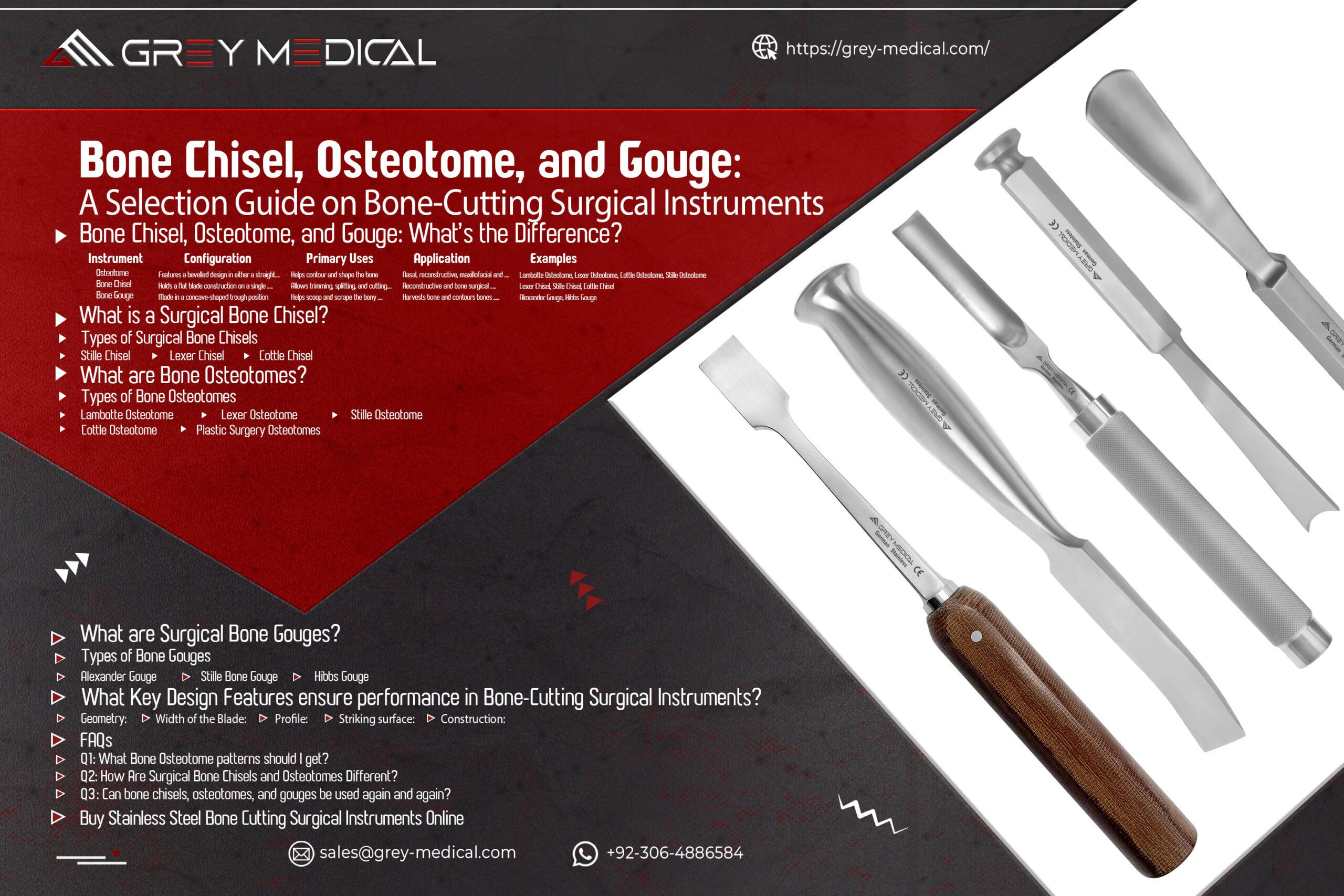
Bone chisels, osteotomes, and gouges are role-specific surgical accessories and instruments made to facilitate trauma-free cutting of hard, bony tissues and anatomical structures. During reconstructive, or selected plastic surgery procedures, surgeons may require specialised instruments to trim, contour, and shape the bone. Therefore, the medical industry has come up with well-structured, specific cutting tools, such as gouges for scooping and scraping action, osteotomes for bevelled cutting, and chisels for contouring.
This selection guide will walk you through a structured account of bone-cutting surgical instruments, such as bone gouges, osteotomes, and chisels. Their key features and types will also be discussed to help you choose the right tool for your procedures.
Bone Chisel, Osteotome, and Gouge: What’s the Difference?
The following table has been compiled to show the difference between the three major bone cutting instruments:
| Instrument | Construction | Primary Uses | Application | Examples |
| Osteotome | Features a bevelled design in either a straight or angled pattern | Helps contour and shape the bone | Nasal, reconstructive, maxillofacial and orthopedic surgical procedures | Lambotte Osteotome, Lexer Osteotome, Cottle Osteotome, Stille Osteotome |
| Bone Chisel | Holds a flat blade construction on a single bevel | Allows trimming, splitting, and cutting of bony anatomical structures | Reconstructive and bone surgical procedures | Lexer Chisel, Stille Chisel, Cottle Chisel |
| Bone Gouge | Made in a concave-shaped trough position | Helps scoop and scrape the bony tissues from pockets | Harvests bone and contours bones during orthopedic procedures | Alexander Gouge, Hibbs Gouge |
Note: Commercial catalogues may showcase combined pattern instruments, such as “chisel-osteotomes”. Therefore, it is important to go through the details and dimensions mentioned below for a tool to prevent any accidental purchase.
What is a Surgical Bone Chisel?
Surgical bone chisels are bone-cutting surgical instruments that feature a flat blade in action against a well-defined area of the bone. They can be obtained in straight, angled, or broad blade designs. Usually, surgeons and orthopedists pair them with a mallet to apply force. Therefore, the tool may hold a well-defined area for the mallet strike.
Types of Surgical Bone Chisels
Stille Chisel
A Stille Chisel is a bone-cutting tool structured in multiple blade widths. Mostly, surgical supply stores list their dimensions somewhere between 10 mm and 25 mm. However, the blade width can always be customised according to the anatomical structure.
Lexer Chisel
A Lexer chisel is a specialised bone-surgery pattern made to cut bones. Usually, they have both straight and curved configurations to suit different surgical needs.
Cottle Chisel
A Cottle Chisel-Osteotome is a specialized bone-cutting composite tool for nasal procedures. They come in different tip widths, suited for different surgical procedures.
What are Bone Osteotomes?
A bone osteotome is a well-defined bone-cutting surgical instrument constructed to chip, trim, and cut the bones during osteotomy. Their cutting ends vary from angled and curved to straight and narrow, or broad. In contrast to chisels, which have single-bevel designs, an osteotome has a better standing as an equal-bevel design. The symmetry of a tool matters a lot and dictates how the tool will navigate through different cutting planes.
Types of Bone Osteotomes
Lambotte Osteotome
In modern practice, an orthopedic surgeon usually has a preference for the Lambotte Osteotome. The range showcases a variety of widths and configurations.
Lexer Osteotome
A Lexer Osteotome provides symmetrical and controlled bone cutting. It can be obtained in different lengths and blade designs. You can also enjoy its mini configurations for confined surgical areas.
Stille Osteotome
A Stille Osteotome comes in multiple blade widths. Most common sizes include 10, 12, 15, 20, and 25 mm.
Cottle Osteotome
Surgeons use a Cottle osteotome when they have a rhinoplasty or a nasal osteotomy at hand. They contribute to cutting bones during lateral osteotomies and feature multiple tip widths for that purpose.
Plastic Surgery Osteotomes
During reconstructive and aesthetic surgeries, plastic surgeons prefer using plastic surgery osteotomes. Usually, during these surgeries, surgeons require osteotomes with narrower working ends and configurations to suit the needs of facial and nasal surgeries.
What are Surgical Bone Gouges?
A surgical bone gouge differs in its structure and functioning from either an osteotome or a chisel, as it features concave working ends. These ends form a trough-like profile that helps surgeons remove bone material by scraping and scooping. This pattern comes into service when the purpose is to remove and empty the bones from inside instead of cutting in singular plane.
Types of Bone Gouges
Alexander Gouge
An Alexander Gouge is a well-established gouge pattern that comes in different widths. Usual sizes range between 5, 7, 9, and 11 mm.
Stille Bone Gouge
Similarly, a Stille Bone Gouge can be obtained for scooping out the bone material. The sizes range from 10, 12, 15, 20, and 25 mm.
Hibbs Gouge
A Hibbs Gouge has a trough-like blade that is partially cylindrical. Apart from scraping, it also helps contour the bones.
What Key Design Features ensure performance in Bone-Cutting Surgical Instruments?
The performance of a bone chisel, osteotome, or a gouge depends on the key design features. Let’s discuss:
- Geometry: Different geometrical patterns exist in bone-cutting surgical instruments, such as single-bevel, flat, or concave. The purpose of these designs is to provide different cutting actions.
- Width of the Blade: Cutting instruments with a narrow blade provide centred cutting action, while tools with broad blades cover a considerable region.
- Profile: Curvature, either straight or angled, should be chosen on account of access and positioning.
- Striking surface: Tools that require a mallet must possess a non-working end.
- Construction: Stainless steel construction protects the tool from developing any rust or corrosion. This material is recommended as the top-most surgical tool construction.
FAQs
Q1: What Bone Osteotome patterns should I get?
Most commonly, orthopedic surgeons and reconstructive professionals use bone osteotome patterns, such as Lexer, Lambotte, Stille, Smith-Petersen, and Macewen.
Q2: How Are Surgical Bone Chisels and Osteotomes Different?
A bone chisel uses a single-bevel design to contour and pare away bone. On the contrary, osteotomes help cut through the bone structures.
Q3: Can bone chisels, osteotomes, and gouges be used again and again?
Yes, chisels, osteotomes, and gouges are compact instruments that can be used again and again. However, it is a
technician’s duty to keep the instrument washed after every use. This enables a safe surgical field.
Buy Stainless Steel Bone Cutting Surgical Instruments Online
Every modern surgical field requires high-impact bone-cutting surgical instruments for quality results during orthopedic and reconstructive surgeries. This article discusses different types, features, and factors regarding bone chisels, osteotomes, and gouges so you can select the right tool for the job. If you are looking for high-performance osteotome and bone chisel manufacturers, contact us now!